


LABSTAMP®
The world’s only automated ID system for identifying mice
Labstamp®
The world’s best method of visually identifying your mice. Better for your science, better for your staff and productivity, and better for the health and welfare of your mice.
- Introduction
- Features
- How it works
- Comparisons
- Customer feedback
Labstamp was launched in 2012 and has since been used to identify over 2 million mice, across more than 300 pre-clinical research organisations in over 15 countries around the world.
Labstamp provides a permanent, visual ID on the tail of mice by applying a choice of up to 3 alpha-numeric characters as tattoos, automatically. Our specially designed font ensures the IDs are consistent, quick and easy to read.
The Labstamp system is so easy to learn, it only takes a few minutes to master and even novice technicians can productively apply the tattoos.
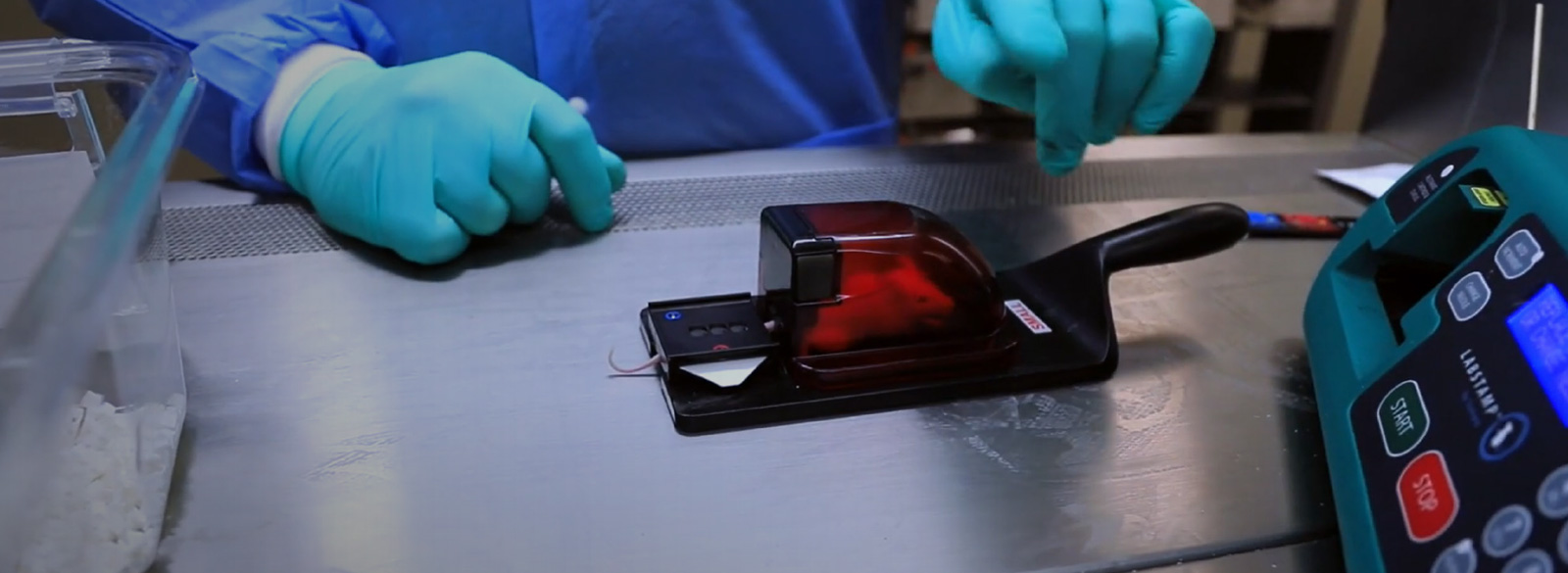
The Labstamp system includes the application unit, a restrainer to keep the tail secure while minimising stress, the tattoo needle, and the TriCell ink slide with specially formulated, irradiated ink.
Our patented design ensures the tattoo ink is applied precisely to the mid-dermal layer of the tail (225–275 µm), producing clear, permanent mouse tail tattoos. Ink options include black for albino colonies or UV for non-albino colonies, ensuring IDs remain readable for the mouse’s lifetime. Each character is applied in about 8 seconds, making the process fast and efficient.
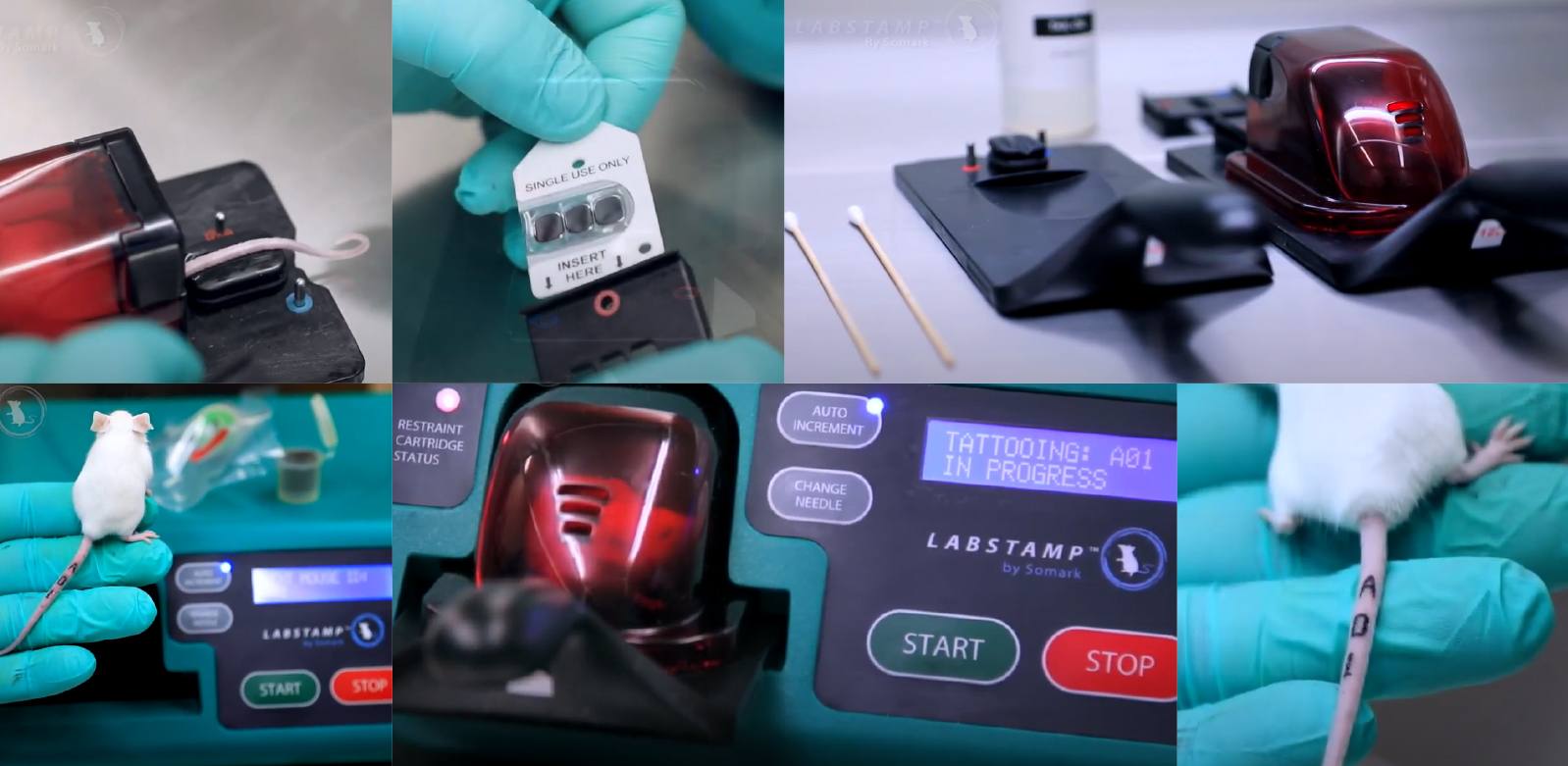
First, restrain the mouse using the unique Labstamp restraint. Measure the tail girth with the provided tail gauge to confirm the correct needle and restraint size, then lightly apply the provided tail oil with a cotton swab.
Place the ink slide into the magnetic tail plate and slide holder, position it over the tail, and program the desired ID (alphanumeric, up to 3 characters, auto-increment if needed). Insert the mouse into the restraint, position in the portal, and press Start.
After 24 seconds (for a 3-character tattoo), the process completes. Remove the mouse and tail plate, clean off excess ink with a cotton swab, and return the mouse to its cage.
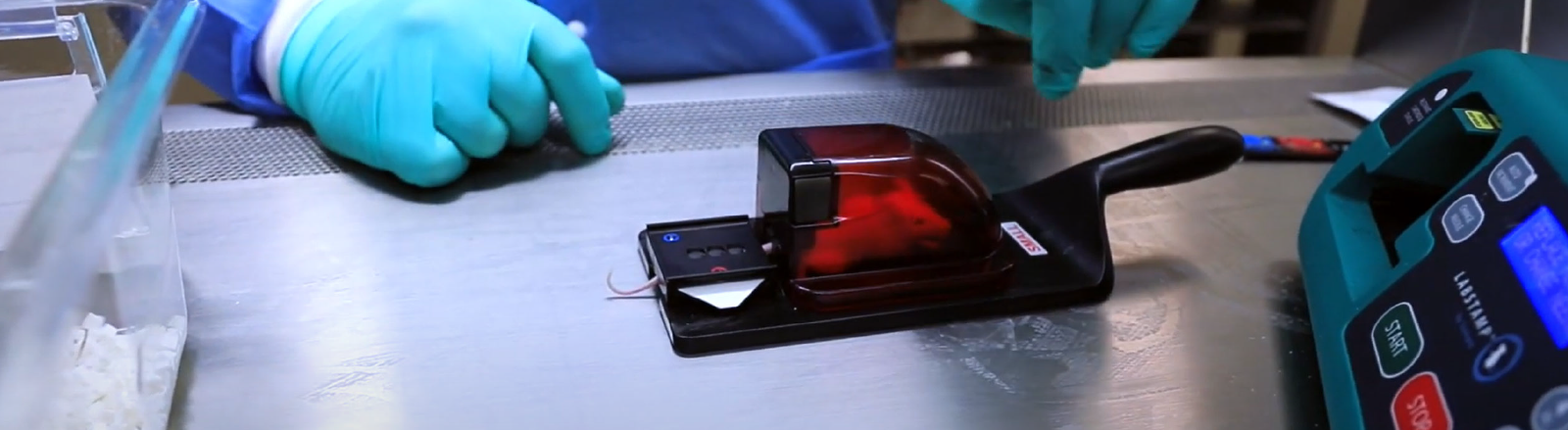
Watch our demo video to see this mouse tail tattoo process in action!
Labstamp was developed to mitigate all the common problems with ear-based identification methods:
- No tissue trauma (torn ears)
- No more ear tags falling out
- No need to treat dermititis
- No worries about auricular chondritis
- Most of all, no errors in reading the mouse ID correctly and at least 25% quicker to read.
Labstamp is a better alternative to pen marks on the tail. Unlike Sharpie marks, which fade quickly, Labstamp tattoos are permanent, apply once and read forever.
Easier to read and simple to apply, Labstamp mouse tail tattoos can be used by any team member, ensuring legible, consistent identification without relying on a specialist.
The automated process produces high-quality, durable tattoos and has universal IACUC/ethics approval, requiring no anesthesia and supporting safe, efficient animal ID.
If you’re interested in gaining some customer insights on the use of Labstamp, please email us at learnmore@somarkinnovations.com. We’ll be happy to provide the information you need.
Labstamp was launched in 2012 and has since been used to identify over 2 million mice, across more than 300 pre-clinical research organisations in over 15 countries around the world.
Labstamp provides a permanent, visual ID on the tail of mice by applying a choice of up to 3 alpha-numeric characters as tattoos, automatically. Our specially designed font ensures the IDs are consistent, quick and easy to read.
The Labstamp system is so easy to learn, it only takes a few minutes to master and even novice technicians can productively apply the tattoos.
The Labstamp system includes the application unit, a restrainer to keep the tail secure while minimising stress, the tattoo needle, and the TriCell ink slide with specially formulated, irradiated ink.
Our patented design ensures the tattoo ink is applied precisely to the mid-dermal layer of the tail (225–275 µm), producing clear, permanent mouse tail tattoos. Ink options include black for albino colonies or UV for non-albino colonies, ensuring IDs remain readable for the mouse’s lifetime. Each character is applied in about 8 seconds, making the process fast and efficient.
First, restrain the mouse using the unique Labstamp restraint. Measure the tail girth with the provided tail gauge to confirm the correct needle and restraint size, then lightly apply the provided tail oil with a cotton swab.
Place the ink slide into the magnetic tail plate and slide holder, position it over the tail, and program the desired ID (alphanumeric, up to 3 characters, auto-increment if needed). Insert the mouse into the restraint, position in the portal, and press Start.
After 24 seconds (for a 3-character tattoo), the process completes. Remove the mouse and tail plate, clean off excess ink with a cotton swab, and return the mouse to its cage.
Watch our demo video to see this mouse tail tattoo process in action!
Labstamp was developed to mitigate all the common problems with ear-based identification methods:
- No tissue trauma (torn ears)
- No more ear tags falling out
- No need to treat dermititis
- No worries about auricular chondritis
- Most of all, no errors in reading the mouse ID correctly and at least 25% quicker to read.
Labstamp is a better alternative to pen marks on the tail. Unlike Sharpie marks, which fade quickly, Labstamp tattoos are permanent, apply once and read forever.
Easier to read and simple to apply, Labstamp mouse tail tattoos can be used by any team member, ensuring legible, consistent identification without relying on a specialist.
The automated process produces high-quality, durable tattoos and has universal IACUC/ethics approval, requiring no anesthesia and supporting safe, efficient animal ID.
If you’re interested in gaining some customer insights on the use of Labstamp, please email us at learnmore@somarkinnovations.com. We’ll be happy to provide the information you need.
Labstamp Training Resources
Watch Labstamp® in action



Labstamp® questions answered…
Labstamp has been designed to eliminate all the problems with ear identification, pen or paint marking and manually tattoos. The tattoos applied by Labstamp require no technical skills or experience. The tattoo can be any number or alphabet character combination and are quick and easy to read. You can read the ID on the tail while the animal is in the cage and you do not even need to pick them up. A Labstamp tattoo is permanent: they do not fall out, get torn, get licked off or need re-application.
No. Labstamp is actually better for the welfare of the mouse. It avoids tissue trauma (common with ear notching and ear tags), dermatitis, auricular chondritis and because it is so easy to read, requires the mouse to be handled less, which reduces stress.rnrnThe restraint and tattoo process takes less than 30 seconds, so the discomfort experienced by the mouse is very short and not lasting. Plus there are not side-effects from the tattoo. With over 2 million mice from over 20 different strains tattooed with Labstamp, no customer has reported any health issues arising from this ID method.
Yes. We offer a specially adapted version of Labstamp called ELI (Early Life Identification) which can provide a 2 character tattoo on mice as young as 14 days old. Even tattoos applied to pups can be read into adulthood and the lifetime of the mouse. Labstamp and ELI is widely used for C57BL/6 strains and also agouti strains. Some customers use our black ink; others prefer to tattoo with our UV Green ink, which displays clearly when a UV light is shone on the tail.
Labstamp®
Why choose Labstamp® for lab rodent identification?
There are several methods available for rodent identification, choosing the right method to suit your laboratory however requires careful consideration. In most cases, data integrity and the improved accuracy of research data become a priority. Additional considerations must also include the welfare of the rodents and the compliance with regulatory standards which govern their protection.
Labstamp is a chosen method of rodent identification which assists in efficient lab animal management, as colonies become more traceable. This is achieved through more efficient read distances and more reliable identifications as the 3-digit alpha-characters are permanent and clear. Identification is just one example of laboratory workflows that can be streamlined through permanent tail tattoos.
Accurate and reliable rodent identification goes on to bring benefits to the preclinical research sector, from accelerated drug candidate journeys to assisting with the advancements in modern medicine.